Search a Hymn

Wednesday, August 12, 2026

REACH THE LOST - lyrics

 In a place of poverty, In a place where millions are so empty With no one  to share God’s love That’s the place  where I want to be, So I can tell them how Jesus died for me

Sent by His Father up above

Here I am I, Lord I will go, I’ll count the cost, I’ll not say “no”In this world of broken dreams, no one cares or so it seems 


CHORUS: 

Lord, help me reach the lost, help me point them to the Cross

I hear voices calling to me, from places so dark, nobody can see

I’ll follow where you lead

Send me


In a place of luxury, and in a church where few seats are empty

With many friends close by

Is where most Christians want to be, so they can live their lives comfortably

While they allow the world to die Are you willing? Will you go? 

Count the cost please don’t say “no”In this world of broken dreams, will you care for those in need? 


CHORUS: 

Will you reach the lost, will you point them to the Cross

There is a world that’s waiting for you, they’re searching for a love that is true

Is God wanting to….

Send you? 


BRIDGE: 

There’s a lost world waiting, trust and obey

Our God needs some Christians to stand up and say… 


CHORUS: 

We will reach the lost, we will point them to the Cross


Many souls are crying from hell, ‘cause nobody had the courage to tell

We must finish well

In a place with golden streets, In a place where joy is everlasting

Where God is the light


Many faces we will see, because we chose to obey God’s calling 

And we surrendered our lives

We must reach the lost

Help Somebody Today - Lyrics


1 Look all around you, find someone in need,

Help somebody today!

Tho' it be little--a neighborly deed--

Help somebody today!


Chorus:

Help somebody today,

Somebody along life’s way;

Let sorrow be ended, the friendless befriended,

Oh, help somebody today!


2 Many are 'waiting a kind, loving word,

Help somebody today!

You have a message, O let it be heard,

Help somebody today! (Chorus)


3 Many have burdens too heavy to bear,

Help somebody today!

Grief is the portion of some everywhere,

Help somebody today! (Chorus)


4 Some are discouraged and weary in heart,

Help somebody today!

Someone the journey to heaven should start,

Help somebody today! (Chorus)

See What God Can Do (Cast it on the ground) - Lyrics

 The Lord said to Moses

“Set My people free!

For I have heard their groanings

And their cryings unto Me.”

But Moses said, “They would not believe,

Nor hearken unto me.”

“Take the rod that is in your hand,

And lay it at My feet.”


And cast it on the ground;

See what I can do.

You don’t know the things

He has planned for you.

And for centuries

When people learn of you,

They’ll see what a little faith

In God can do.


The Lord is calling you

To set this dying world free.

but you are scared or unprepared;

You’re sure they won’t believe.

The rod you’re holding is holding you.

Release it from your hand.

Let go of all you think you know.

Surrender to God’s plan.


And cast it on the ground;

See what God can do.

You don’t know the things

He has planned for you.

And for centuries

When people learn of you,

They’ll see what a little faith

In God can do.


Noah built an ark

Though he had never seen it rain,

And Abraham laid Isaac down

Though it caused him great pain.

What is the trial of your faith?

What is in thine hand?

Lay it down at the feet

Of the Great I Am!


And cast it on the ground;

See what God can do.

You don’t know the things

He has planned for you.

And for centuries

When people learn of you,

They’ll see what a little faith

In God can do.


Learn what a little faith

In God can do.


Fight On Lyrics

 (1) Sometimes the battle rages on

And everything goes wrong.

You tell yourself it’s more than

You can bear

You hardly have the strength 

For another day.

It seems to you that every

Ray of hope is truly gone.


 Chorus: 

 _But just fight on though your

Heart is heavy, fight on.

Though your soul is weary, fight on; 

There is victory to be won. 

Keep on walking and talking 

And living and giving 

And telling the world of Jesus. 

Though you faint, keep pursuing 

One more day, one more hour. 

Just stay in the battle, fight on._ 


(2) This battle that we fight down here, 

We have no need to fear. 

Though the world around 

Us sits on sinking sand, 

Our Saviour is the Rock 

That standeth sure,

Deliverer, our surety, strength.

A high and mighty tower


(3) Remember when temptation comes 

Throw it other way 

A little boy and girl are watching you 

They will stumble or stand 

As they follow you 

So give them hope 

And carry on 

No matter come what may 


 Last Chorus: 

 _And just fight on though your

Heart is heavy, fight on.

Though your soul is weary, fight on; 

There is victory to be won. 

Keep on walking and talking 

And living and giving 

And telling the world of Jesus. 

Though you faint, keep pursuing 

One more day, one more hour. 

Just stay in the battle, fight on.


Keep on walking and talking 

And living and giving 

And telling the world of Jesus. 

Though you faint, keep pursuing 

One more day, one more hour. 

Just stay in the battle, fight on.


Just stay in the battle, fight on.

Thursday, January 1, 2026

364. What a Friend We Have in Jesus


1 What a friend we have in Jesus,
all our sins and griefs to bear!
What a privilege to carry
everything to God in prayer!
O what peace we often forfeit,
O what needless pain we bear,
all because we do not carry
everything to God in prayer!


2 Have we trials and temptations?
Is there trouble anywhere?
We should never be discouraged;
take it to the Lord in prayer!
Can we find a friend so faithful
who will all our sorrows share?
Jesus knows our every weakness;
take it to the Lord in prayer!


3 Are we weak and heavy laden,
cumbered with a load of care?
Precious Savior, still our refuge--
take it to the Lord in prayer!
Do your friends despise, forsake you?
Take it to the Lord in prayer!
In his arms he'll take and shield you;
you will find a solace there.

Thursday, July 24, 2025

Heart Longings Hymn With Lyrics

1. Heart longings, Lord Jesus, I lift to the throne:
For grace, and for fullness of soul;
While, hungry and thirsty, my heart asks alone
Thy Spirit, poured forth to make whole.
Lord Jesus, grant grace in its fullness
Brimfull in my heart to be poured;
Thou only my strength and my wholeness,
Yes, Thou art my plenty, Lord!

2. Lord Jesus, break from me the bonds of my sin,
That I may be pure, every part;
Let earthly deceits have no lodging within,
No crevice to hide in my heart.
Lord Jesus, grant grace in its fullness
Brimfull in my heart to be poured;
Thou only my strength and my wholeness,
Yes, Thou art my plenty, Lord!

3. Lord Jesus, grant faith such as Jacob's that night,
To wrestle in prayer and not cease;
And though the world's billows mount high in their might,
Still grant me the gift of Thy peace.
Lord Jesus, grant grace in its fullness
Brimfull in my heart to be poured;
Thou only my strength and my wholeness,
Yes, Thou art my plenty, Lord!

4. Lord Jesus, let love like the love in Thy heart
Be mine without let or alloy
Until I am filled to the uttermost part,
To live in Thy love and Thy joy.
Lord Jesus, grant grace in its fullness
Brimfull in my heart to be poured;
Thou only my strength and my wholeness,
Yes, Thou art my plenty, Lord!

5. Lord Jesus, I know that Thy Spirit, who came
To live in my heart, there will dwell.
Now grant the great gift in the strength of Thy name
That I may but serve my Lord well.
Lord Jesus, grant grace in its fullness
Brimfull in my heart to be poured;
Thou only my strength and my wholeness,
Yes, Thou art my plenty, Lord!


Scripture; Matthew 5:6, Psalm 42:1-2, Psalm 63:1, Isaiah 55:1-3


The hymn “Heart Longings” is one of those tender, devotional songs that speaks to the inmost desires of a soul yearning for deeper fellowship with God. Though not as widely known as other classics, its heartfelt language and spiritual depth have made it meaningful to many believers seeking renewal, quietness, and communion with the Lord. While there is limited public documentation about the hymn’s first publication or the full biography of its author in standard hymnals, the emotional and theological background of the hymn reveals its roots in a period of personal and spiritual introspection.

“Heart Longings” was written during a time when many hymnwriters were exploring themes of personal holiness, deeper consecration, and the indwelling presence of the Holy Spirit. These themes were particularly emphasized during the late 19th and early 20th centuries, in the aftermath of revival movements in both America and Britain. Many believers who had already come to saving faith in Christ began to desire something more—an ongoing, abiding experience with God that went beyond initial conversion. Hymns like “Heart Longings” expressed this growing hunger.

The anonymous or little-known author of this hymn may have drawn inspiration from Psalm 42 or Psalm 63, where David describes his deep yearning for God in the wilderness. The language used in “Heart Longings” reflects that same spiritual thirst—a desire not merely to perform religious duty, but to dwell in the presence of God, to hear His voice, and to walk in His Spirit. For many believers, the hymn became a private prayer set to music, an invitation for God to enter the hidden places of the soul and fill them with His peace and power.

One of the possible reasons this hymn resonates so deeply is because it doesn’t focus on outward achievement or dramatic conversion, but on inward longing—a theme that often goes unspoken in church music. The singer is not boasting of spiritual triumph but instead acknowledging a holy discontent: “My soul is not satisfied with anything less than You, Lord.” This vulnerability is part of what makes “Heart Longings” timeless.

In devotional gatherings, especially during quiet evening services or prayer meetings, the hymn was often sung softly, almost like a whisper of the heart. Its influence may not be as widely published or celebrated as hymns like “Just As I Am” or “I Need Thee Every Hour,” but it falls within the same family of songs that speak of spiritual intimacy and surrender.

In many hymnals where it appears, “Heart Longings” is placed among the hymns about consecration, revival, or quiet time with God. These contexts highlight its purpose—not to stir loud emotion but to invite reflection and a heartfelt return to God’s presence.

Whether the hymn was born from personal sorrow, revival fire, or a simple moment of quiet prayer, it continues to serve as a musical expression of what many Christians feel in their journey with the Lord—a longing that nothing else in the world can satisfy. It remains a spiritual echo of the soul’s deepest cry: “Draw me nearer, Lord; dwell within me; still my heart until it beats with Yours.”

If you'd like, I can attempt to trace the hymn’s first publication or its composer with more detail. Do you have a version of the lyrics or know which hymnal it appears in? That would help narrow down the origin further.

Tuesday, July 22, 2025

God give us the patience - Hymn With Lyrics

1. God, give us the patience through sickness and pain
When we are in sickness without any hope.
Oh, Lord Oh, Lord Give us patience in us.

2. God, give us the patience through sickness and pain
When we are in trouble tempted in our life.
Oh, Lord Oh, Lord Give us patience in us.

3. God, give us the patience through sickness and pain
Give us consolation by Your loving help.
Oh, Lord Oh, Lord Give us patience in us.

4. God, give us the patience through sickness and pain
Keep us by Your stronghand when we fall in sin.
Oh, Lord Oh, Lord Give us patience in us.

5. God, give us the patience through sickness and pain
With a heavy burden when we are oppressed.
Oh, Lord Oh, Lord Give us patience in us.

6. God, give us the patience through sickness and pain
People in the darkness, make us forgive them.
Oh, Lord Oh, Lord Give us patience in us.


Scripture; Romans 5:3–4, James 1:3–4, Galatians 5:22, Colossians 3:12–13


The hymn “God, Give Us the Patience” is lesser known in mainstream hymnals, but its message echoes a timeless Christian longing: the humble plea for spiritual patience in the face of life’s trials and everyday burdens. While the hymn may not have a widely documented publication history or an immediately recognizable author like Fanny Crosby or Charles Wesley, its content places it firmly within the devotional tradition of 19th and early 20th-century Protestant hymnody. These were eras when hymns were often composed not only for public worship but also for personal prayer and family devotion. “God, Give Us the Patience” falls squarely in that category, and it likely originated in a context where believers sought spiritual formation through simple, heartfelt songs.

The hymn’s text is usually a petition asking for the kind of patience that reflects the endurance of Christ. Patience in Christian teaching is not merely passive waiting; it is spiritual fortitude under pressure, a grace that allows the believer to hold steady in faith while life presses hard. This is the kind of virtue that cannot be manufactured through willpower alone—it must be given by God, just as the hymn asks. Its tone is prayerful and honest, confessing that patience is hard to maintain and must be constantly renewed by divine help.

Though not as widely published as other classic hymns, it is possible that “God, Give Us the Patience” was circulated in smaller church collections, Sunday school hymnals, or denominational publications in the early 20th century. Many such hymns were written anonymously or by local pastors, teachers, or women’s group leaders who crafted songs for specific needs—be it enduring wartime separation, surviving illness, or raising families in poverty. The language of the hymn suggests it may have been used in prayer meetings, midweek services, or personal devotional times rather than in large Sunday worship gatherings.

Its sentiments connect strongly with scriptures like James 1:3–4 and Romans 5:3–5, which speak of the spiritual fruit produced through trials. The hymn does not ask for trials to be taken away, but for grace to endure them rightly—a mark of spiritual maturity. This parallels the theology of sanctification common in both Methodist and Reformed traditions, where the believer seeks to be shaped more into the image of Christ through daily submission to God's will.

The historical background of the hymn may also tie into the post-war or industrial periods, when life for many Christians was especially difficult. Families struggling through the Great Depression or recovering from World War I or II often turned to prayerful hymns as sources of hope and perseverance. Hymns like this one gave them words to say when their own strength had failed. In such moments, songs became both a testimony and a lifeline.

Though it lacks wide commercial publication, “God, Give Us the Patience” remains relevant because its plea is timeless. Christians in every generation find themselves in situations that test their endurance, whether through illness, loss, frustration, or waiting. And in every generation, believers return to the quiet prayer: “God, give us the patience.” The hymn becomes not just a song, but a spiritual practice—a way to realign the heart with the slow, faithful, unseen work of God in daily life.
Its legacy, though small in scale, is significant in spirit. It stands among those devotional hymns that never became famous but were deeply loved in quiet places—living rooms, hospital bedsides, and small prayer circles—where patienceThe hymn “God, Give Us the Patience” is lesser known in mainstream hymnals, but its message echoes a timeless Christian longing: the humble plea for spiritual patience in the face of life’s trials and everyday burdens. While the hymn may not have a widely documented publication history or an immediately recognizable author like Fanny Crosby or Charles Wesley, its content places it firmly within the devotional tradition of 19th and early 20th-century Protestant hymnody. These were eras when hymns were often composed not only for public worship but also for personal prayer and family devotion. “God, Give Us the Patience” falls squarely in that category, and it likely originated in a context where believers sought spiritual formation through simple, heartfelt songs.

The hymn’s text is usually a petition asking for the kind of patience that reflects the endurance of Christ. Patience in Christian teaching is not merely passive waiting; it is spiritual fortitude under pressure, a grace that allows the believer to hold steady in faith while life presses hard. This is the kind of virtue that cannot be manufactured through willpower alone—it must be given by God, just as the hymn asks. Its tone is prayerful and honest, confessing that patience is hard to maintain and must be constantly renewed by divine help.

Though not as widely published as other classic hymns, it is possible that “God, Give Us the Patience” was circulated in smaller church collections, Sunday school hymnals, or denominational publications in the early 20th century. Many such hymns were written anonymously or by local pastors, teachers, or women’s group leaders who crafted songs for specific needs—be it enduring wartime separation, surviving illness, or raising families in poverty. The language of the hymn suggests it may have been used in prayer meetings, midweek services, or personal devotional times rather than in large Sunday worship gatherings.

Its sentiments connect strongly with scriptures like James 1:3–4 and Romans 5:3–5, which speak of the spiritual fruit produced through trials. The hymn does not ask for trials to be taken away, but for grace to endure them rightly—a mark of spiritual maturity. This parallels the theology of sanctification common in both Methodist and Reformed traditions, where the believer seeks to be shaped more into the image of Christ through daily submission to God's will.

The historical background of the hymn may also tie into the post-war or industrial periods, when life for many Christians was especially difficult. Families struggling through the Great Depression or recovering from World War I or II often turned to prayerful hymns as sources of hope and perseverance. Hymns like this one gave them words to say when their own strength had failed. In such moments, songs became both a testimony and a lifeline.

Though it lacks wide commercial publication, “God, Give Us the Patience” remains relevant because its plea is timeless. Christians in every generation find themselves in situations that test their endurance, whether through illness, loss, frustration, or waiting. And in every generation, believers return to the quiet prayer: “God, give us the patience.” The hymn becomes not just a song, but a spiritual practice—a way to realign the heart with the slow, faithful, unseen work of God in daily life.


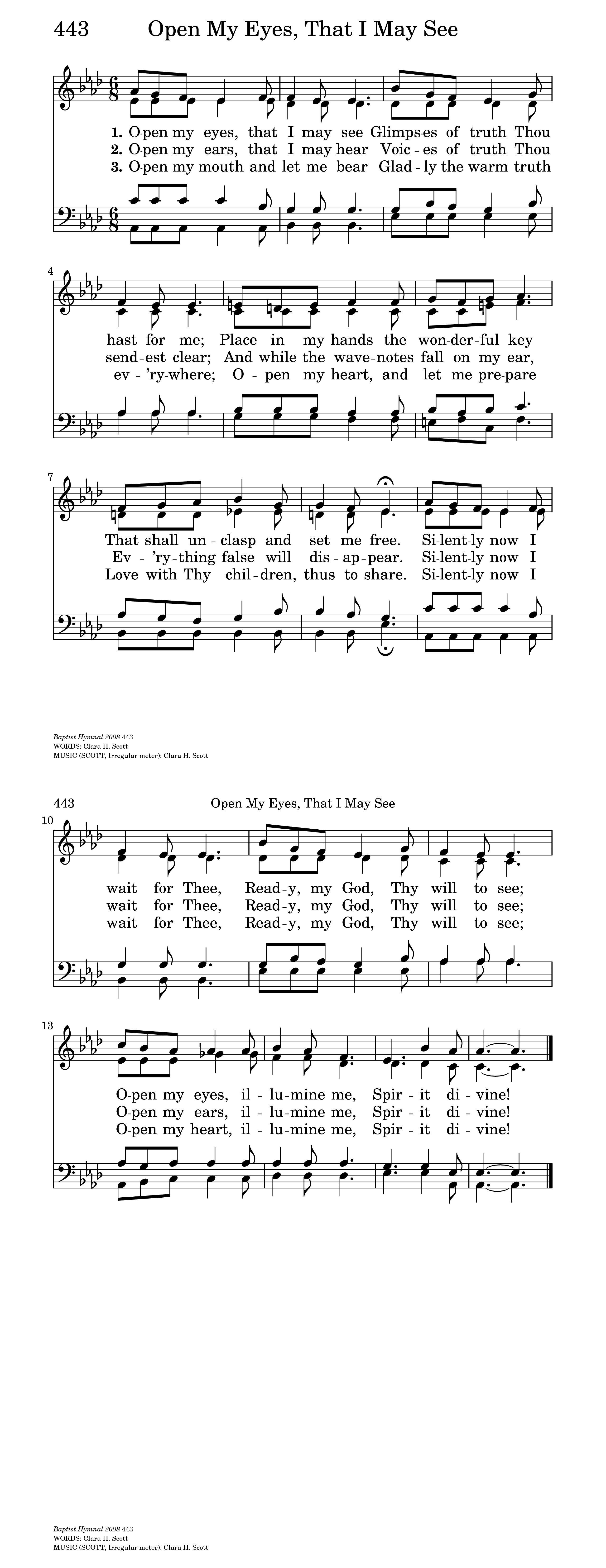
Open My Eyes, that I May See - Hymn With Lyrics

1. Open my eyes, that I may see
glimpses of truth Thou hast for me;
place in my hands the wonderful key,
that shall unclasp and set me free.
Silently now I wait for Thee,
ready, my God, Thy will to see;
open my eyes, illumine me,
Spirit divine!

2. Open my ears, that I may hear
voices of truth Thou sendest clear;
and while the wave-notes fall on my ear,
ev’rything false will disappear.
Silently now I wait for Thee,
ready, my God, Thy will to see;
open my ears, illumine me,
Spirit divine!

3. Open my mouth, and let me bear
gladly the warm truth ev’rywhere;
Open my heart, and let me prepare
love with Thy children thus to share.
Silently now I wait for Thee,
ready, my God, Thy will to see;
open my mouth, illumine me,
Spirit divine!


Scripture; 
Exodus 4:12, 
Psalm 40:6
Proverbs 15:31, 
Isaiah 29:18

The hymn "Open My Eyes, That I May See" was written by Clara H. Scott in 1895, the same year she tragically passed away. A gifted composer, poet, and musician, Clara Scott was one of the first women in America to publish a volume of anthems for choirs. She was born in Elk Grove, Illinois, in 1841, and her life was devoted to music, teaching, and spiritual songwriting. With a deep Christian faith and a love for sacred music, she sought to uplift souls through song.

This particular hymn was inspired by Psalm 119:18, which says, “Open thou mine eyes, that I may behold wondrous things out of thy law.” This verse captures the prayerful heart of the believer who longs to receive divine insight—not just physical sight, but spiritual understanding. Scott’s lyrics reflect this yearning. Each stanza opens with a plea: "Open my eyes," "Open my ears," and "Open my mouth." These are more than sensory requests; they are spiritual aspirations to perceive God more clearly, hear His truth more faithfully, and speak His praise more sincerely.

The hymn was composed during a period when the American church was undergoing a deepening of spiritual expression, and hymns were increasingly becoming prayers in themselves. Unlike many hymns focused on doctrine or proclamation, "Open My Eyes, That I May See" is introspective and meditative. It's a quiet surrender, a hymn of spiritual consecration. The gentle tone and simple structure make it deeply personal, almost like a private prayer set to music.

The tune was also composed by Clara Scott herself. Its flowing melody complements the reflective nature of the lyrics. It's neither bombastic nor dramatic, but calm and tender, inviting quiet meditation and reverence. This made it a favorite for moments of devotion, prayer meetings, and altar calls. The music and words are perfectly matched in their spirit of submission and desire for divine enlightenment.

Tragically, Clara Scott died shortly after composing this hymn. She was thrown from a carriage in a freak accident involving a frightened horse, marking a sudden end to a promising and impactful life. She never saw the long-lasting legacy her hymn would have. Though she wrote other music and hymns, "Open My Eyes, That I May See" remains her most enduring work. Its message continues to resonate with generations of Christians longing for deeper spiritual understanding.

The hymn’s legacy lies in its timeless relevance. In every age, believers face distractions, spiritual dullness, and confusion. Clara Scott's prayer—quiet and sincere—is as vital today as it was in 1895. With each verse, she reminds us that spiritual clarity comes not by human effort, but by divine revelation. And so, when we sing this hymn, we join her in that simple yet profound request: "Open my eyes, that I may see..."

It is fitting that Clara’s final published work was one that asked for spiritual vision. Her own eyes were closed to this world shortly after, but she left behind a hymn that has helped countless others open theirs—to truth, to beauty, and to God.


Wednesday, July 16, 2025

Are You Weary - Hymn With Lyrics

1. Are you weary, are you heavyhearted?
Tell it to Jesus,
Tell it to Jesus;
Are you grieving over joys departed?
Tell it to Jesus alone.

Chorus:
Tell it to Jesus, tell it to Jesus,
He is a friend that's well known;
You've no other such a friend or brother,
Tell it to Jesus alone.

2. Do the tears flow down your cheeks unbidden?
Tell it to Jesus,
Tell it to Jesus;
Have you sins that to men's eyes are hidden?
Tell it to Jesus alone.

3. Do you fear the gath'ring clouds of sorrow?
Tell it to Jesus,
Tell it to Jesus;
Are you anxious what shall be tomorrow?
Tell it to Jesus alone.

4. Are you troubled at the thought of dying?
Tell it to Jesus,
Tell it to Jesus;
For Christ's coming kingdom are you sighing?
Tell it to Jesus alone.


Scripture; 
Proverbs 18:24, 
Matthew 14:12, 
Luke 11:9, 
Ephesians 6:18


The hymn "Are You Weary, Are You Heavy Laden?"—often simply referred to as “Are You Weary?”—is a deeply tender and compassionate invitation to the soul that is burdened, exhausted, or seeking rest in Christ. The hymn was originally written by John Mason Neale (1818–1866), a 19th-century Anglican priest, scholar, and hymn translator, and is a loose English adaptation of a much older Greek text from the early Christian church.

The original text that inspired this hymn was a portion of a long Greek poem titled “Jesu, Name All Names Above” written by St. Stephen the Sabaite, a monk who lived in the 8th century in the deserts of Palestine. St. Stephen was a nephew and disciple of St. John of Damascus and lived in the monastic community of Mar Saba near Jerusalem. His writings, mostly devotional poetry, were rich with expressions of yearning, trust, and reverence for Christ.

John Mason Neale, who is best known for his work translating ancient and medieval hymns into English, discovered this Greek text and rendered it into a lyrical English paraphrase in the mid-19th century. Neale was a man of deep learning and piety, though often criticized by his contemporaries in the Church of England for his sympathy toward ancient liturgical traditions and rituals. He founded the Society of Saint Margaret and spent much of his life aiding the poor and ill, even as he labored to bring the treasures of ancient Christian worship into the English-speaking world.

“Are You Weary?” was first published in 1862 in Neale’s collection Hymns of the Eastern Church. It immediately stood out for its unusual style: a series of questions and answers that gently lead the hearer toward Christ. The hymn’s format is a kind of dialogue, where a soul seeking hope poses questions, and the answer consistently points to the person and heart of Jesus.

Are you weary, are you heavy laden?
Tell it to Jesus, tell it to Jesus.
Are you grieving over joys departed?
Tell it to Jesus alone.

The repeated assurance is that Christ knows, understands, and welcomes those who are burdened. The hymn echoes Jesus' own words in Matthew 11:28 (KJV): “Come unto me, all ye that labour and are heavy laden, and I will give you rest.”

The early versions of Neale’s hymn used slightly different phrasing and structure than the modern form most familiar today. Some versions start with:

Art thou weary, art thou languid,
Art thou sore distressed?

“Come to Me,” saith One, “and coming,
Be at rest.”

Over time, the hymn has been slightly adapted and sometimes retitled. In American hymnals, the version arranged by Elisha A. Hoffman, who wrote the music and adapted the text under the title “Are You Weary, Are You Heavy Laden?”, became particularly popular. Hoffman was a prolific 19th-century American hymn writer and composer, known for hymns like “Leaning on the Everlasting Arms” and “I Must Tell Jesus.” He preserved Neale’s spirit of gentle encouragement but made the phrasing more direct and accessible to congregational singing.

The hymn’s enduring power lies in its gentle, pastoral tone and its direct appeal to human need. It does not begin with lofty theology but with heartfelt questions—Are you weary? Are you sorrowful? Are you struggling?—and answers each one with the sufficiency of Christ. It reminds the singer that Jesus, who suffered and triumphed, now stands ready to comfort and carry every weary heart.

“Are You Weary?” is often used in revival meetings, personal devotion, and funerals, especially where comfort and assurance are needed. It carries no triumphalism but is full of quiet confidence in the compassion and presence of Christ.

Through Neale’s scholarship and heart, and through Hoffman’s musical setting, the voice of a desert monk from the 8th century continues to echo across centuries: inviting the weary, the burdened, and the broken to find their rest in Jesus alone.


Rejoice Hymns page 559


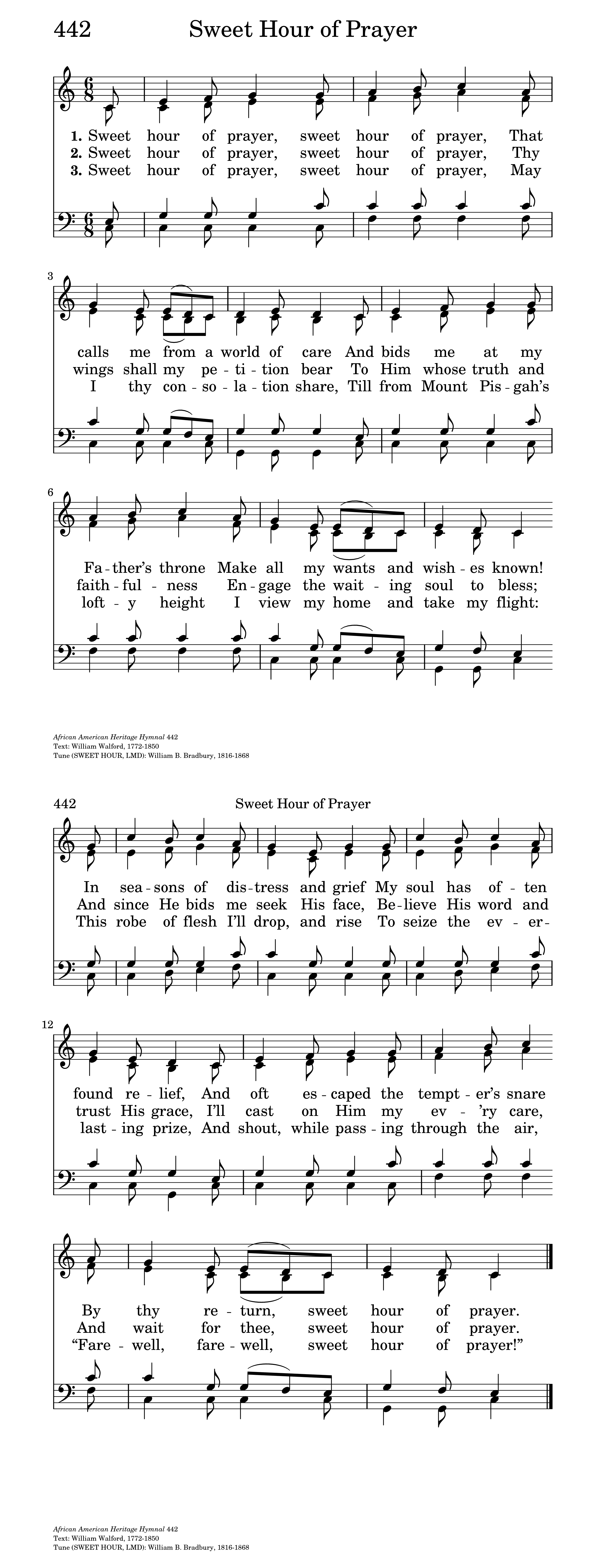
Sweet Hour of Prayer - Hymn With Lyrics

1. Sweet hour of prayer! sweet hour of prayer!
that calls me from a world of care,
and bids me at my Father's throne
make all my wants and wishes known.
In seasons of distress and grief,
my soul has often found relief,
and oft escaped the tempter's snare
by thy return, sweet hour of prayer!

2. Sweet hour of prayer! sweet hour of prayer!
the joys I feel, the bliss I share
of those whose anxious spirits burn
with strong desires for thy return!
With such I hasten to the place
where God my Savior shows his face,
and gladly take my station there,
and wait for thee, sweet hour of prayer!

3. Sweet hour of prayer! sweet hour of prayer!
thy wings shall my petition bear
to him whose truth and faithfulness
engage the waiting soul to bless.
And since he bids me seek his face,
believe his word, and trust his grace,
I'll cast on him my every care,
and wait for thee, sweet hour of prayer!


Scripture; Deuteronomy 3:27, Psalm 4:17, Matthew 6:1-7, 
Mark 1:35


The beloved hymn “Sweet Hour of Prayer” was written by William W. Walford, a blind English lay preacher, and first published in 1845. Its touching message and simple yet heartfelt language have made it a lasting favorite in churches around the world. The hymn speaks of the comfort, power, and spiritual refreshment found in time spent in prayer, portraying it as a precious hour where the soul draws near to God and finds peace, strength, and hope.

William Walford was born in England around 1772. Though blind from a young age, he was deeply committed to his faith. He was known to be a man of prayer, a devoted student of the Bible, and someone who memorized large portions of Scripture. Despite his physical limitation, he served as a preacher in his local church and operated a small trinket and woodcraft shop in his village. It is said that Walford could quote entire chapters of the Bible by heart, and he often composed sermons and verses mentally, dictating them to others.

The story of how “Sweet Hour of Prayer” came to be known and published is itself humble and touching. In the early 1840s, an American minister named Thomas Salmon, who was living in Coleshill, Warwickshire, England, became acquainted with Walford. During one of their conversations, Walford dictated to Salmon the verses of a poem he had composed on the subject of prayer. Deeply moved by the poem’s sincerity and beauty, Salmon wrote it down and later brought it with him to the United States.

In 1845, the poem was published anonymously in the New York Observer, a religious periodical, under the title “Sweet Hour of Prayer.” The poem resonated deeply with readers, especially in an era when revivals were common, and personal devotion was highly valued. Over time, the words were set to music by William B. Bradbury, a prominent American composer of hymn tunes. Bradbury’s melody, gentle and flowing, perfectly matched the contemplative and comforting spirit of Walford’s text, helping to elevate it to enduring popularity.

The hymn’s three stanzas describe a progression in the experience of prayer. The first stanza emphasizes prayer as a time of communion with God—a refuge from the cares and griefs of life. It paints a picture of the soul escaping from the burdens of the world to find solace and spiritual refreshment.

Sweet hour of prayer, sweet hour of prayer,
That calls me from a world of care,
And bids me at my Father’s throne,
Make all my wants and wishes known…

The second stanza focuses on the power of prayer to bring comfort in times of distress and uncertainty. It testifies to the way prayer strengthens faith, draws the heart toward heaven, and connects the believer to divine promises.

The third stanza looks forward to the hope of heaven. It expresses a desire to leave behind earthly burdens and meet the Lord face to face. The line “And shout while passing through the air, Farewell, farewell, sweet hour of prayer” is particularly striking—it envisions the end of life not as a loss, but as a glorious beginning, where prayer is no longer needed because the soul is in direct presence with God.

Though not much else is known about William Walford’s life, his hymn continues to speak for him. His blindness and simple station in life did not prevent him from composing one of the most enduring expressions of Christian devotion. His hymn stands as a testament to the richness of a life rooted in prayer, and to the truth that God often uses quiet, humble voices to inspire generations.

“Sweet Hour of Prayer” remains a deeply loved hymn in evangelical, Methodist, Baptist, and many other church traditions. It has been included in hundreds of hymnals and sung in countless worship services, prayer meetings, and quiet moments of personal reflection. Its enduring appeal lies in its gentle melody and timeless message—a reminder that in the busy and often harsh world, the soul finds rest and strength in the sweet, sacred hour spent in communion with God.


From the Depths, O Lord, I Cry - Hymn with Lyrics

1. Out of the depths I cry to you;
O Lord God, hear me calling.
Incline your ear to my distress
in spite of my rebelling.
Do not regard my sinful deeds.
Send me the grace my spirit needs;
without it I am nothing.

2. All things you send are full of grace;
you crown our lives with favor.
All our good works are done in vain
without our Lord and Savior.
We praise you for the gift of faith;
you save us from the grip of death;
our lives are in your keeping.

3. In you alone, O God, we hope,
and not in our own merit.
We rest our fears in your good word;
uphold our fainting spirit.
Your promised mercy is my fort,
my comfort, and my strong support;
I wait for it with patience.

4. My soul is waiting for you, Lord,
as one who longs for morning;
no watcher waits with greater hope
than I for your returning.
I hope as Israel in the Lord,
who sends redemption through the Word.
Praise God for grace and mercy!


Scripture;  Psalm 40:1-4, Psalm 40:11-12, Habakkuk 2:3-4, 
Galatians 2:16


The hymn "From the Depths, O Lord, I Cry" is a metrical paraphrase of Psalm 130, one of the penitential psalms of the Bible, and has its roots in deep spiritual sorrow, heartfelt repentance, and hopeful trust in God's mercy. Its history is tied closely to the Reformation and the tradition of singing the Psalms in worship, particularly in the German Lutheran and later the English-speaking Protestant traditions.

The original source of this hymn is the German Lutheran chorale titled “Aus tiefer Not schrei ich zu dir”, written by Martin Luther around 1523. This hymn was Luther’s paraphrase of Psalm 130, also known as De profundis (Latin for "Out of the depths"), and it became one of the earliest and most enduring hymns of the Reformation. Psalm 130 had long been considered a powerful expression of personal and communal repentance, and Luther was deeply moved by its message. As someone who had personally wrestled with guilt, fear of judgment, and the doctrine of justification by faith, Luther found in Psalm 130 a direct expression of the soul's cry to God for forgiveness.

Luther’s version in German preserved the intensity of the psalm’s anguish but also emphasized the hope and assurance found in God’s grace. He set it to a somber but majestic tune that he likely helped compose or arrange. The hymn was published in 1524 in the first Lutheran hymnal, the Achtliederbuch, and quickly spread throughout German-speaking churches. For centuries, it was one of the most frequently sung hymns in times of sorrow, death, or spiritual crisis.

The English version, “From the Depths, O Lord, I Cry,” is one of several translations of Luther’s hymn or direct paraphrases of Psalm 130. It maintains the psalm’s posture of humble pleading. The structure of the hymn usually reflects the progression of the original psalm: beginning with a desperate cry for mercy, acknowledging God's forgiveness, warning against self-righteousness, and ending with confident waiting and hope in God's redemptive power.

The psalm’s opening line—“Out of the depths have I cried unto thee, O LORD” (Psalm 130:1, KJV)—has resonated deeply throughout church history. The “depths” refer not only to physical suffering or calamity but to the inner awareness of sin and separation from God. The psalmist, like the hymn writer, knows that only God can offer the forgiveness and restoration his soul craves.

“From the Depths, O Lord, I Cry” has appeared in numerous hymnals in various metrical forms. Sometimes it closely follows Luther’s version; other times it draws more directly from the King James translation of Psalm 130. Regardless of the form, the hymn retains the deep spirit of penitence and trust that characterizes the original Scripture.

During the Reformation and long afterward, it was common to sing psalm paraphrases like this in both public worship and private devotion. “From the Depths” was often sung at funerals, during Lent, or in times of national mourning or personal grief. The tune associated with Luther’s original hymn—also titled "Aus tiefer Not"—is a haunting melody in the Phrygian mode, which adds solemnity and gravity to the prayerful text.

Johann Sebastian Bach famously used this hymn in his compositions, notably in his chorale prelude BWV 686 and 687, and in his cantatas. The theological richness of Psalm 130, coupled with its emotional rawness, gave composers and worshippers alike a profound spiritual vocabulary for expressing repentance and hope.

In many modern hymnals, “From the Depths, O Lord, I Cry” is still included, though often with updated language for accessibility. Whether sung in its original German, in a stately English metrical version, or even chanted from Scripture, the hymn continues to give voice to those who, like the psalmist, know what it is to cry to God from the pit of despair and yet cling to His mercy.

In sum, “From the Depths, O Lord, I Cry” is not simply a hymn of sorrow—it is a hymn of repentance, humility, and hope. Rooted in Scripture and shaped by centuries of Christian devotion, it speaks to the heart of the Gospel: that God hears the cries of sinners and offers redemption to those who wait on Him in faith.


Lord, I Hear of Showers of Blessing - Hymn With Lyrics

1. Lord, I hear of showers of blessing
Thou art scattering full and free,
Showers, the thirsty land refreshing;
Let some showers fall on me,
Even me.

2. Pass me not, O gracious Father,
Sinful though my heart may be;
Thou might’st leave me, but the rather
Let thy mercy light on me,
Even me.

3. Pass me not, O mighty Spirit,
Thou canst make the blind to see;
Witnesser of Jesus’ merit,
Speak the word of power to me,
Even me.

4. Love of God so pure and changeless,
Blood of Christ so rich and free,
Grace of God so strong and boundless,
Magnify them all in me,
Even me.


Scripture;  Genesis 27:34, Genesis 27:38, Psalm 27:9, Proverbs 3:5


The hymn “Lord, I Hear of Showers of Blessing” was written by Elizabeth Codner in the mid-19th century and has touched countless hearts with its earnest longing for personal spiritual revival. The backdrop of this hymn is closely tied to the spiritual awakenings that swept across parts of England and Wales during the 1850s and 1860s, and its lyrics reflect a deeply personal cry for inclusion in the outpourings of divine grace.

Elizabeth Codner (1823–1919), an Englishwoman, was active in Christian ministry alongside her husband, a clergyman. She was a devout evangelical and engaged in Sunday school work and mission efforts. She was particularly stirred by reports of revival occurring in different parts of Britain. In 1860, during a service where testimonies were shared about conversions and blessings being experienced elsewhere, Codner felt overwhelmed with both joy for others and a deep yearning for her own soul and those around her to experience the same.

One Sunday, after hearing young people in her congregation speak about these “showers of blessing” happening in other places, Codner was struck by the contrast between what was happening elsewhere and the dryness she perceived locally. That evening, her heart ached for the presence of God to descend upon her own church and community. She took up a pen and began to write what became the hymn “Lord, I Hear of Showers of Blessing.”

The opening line—*“Lord, I hear of showers of blessing, Thou art scattering full and free”—*expresses a mix of hope and heartache. It acknowledges that God is working powerfully in other places but pleads, “Let some drops now fall on me.” This refrain captures the essence of the hymn: a humble, prayerful request not to be left out of God's renewing work. Codner didn’t write from a place of bitterness, but from sincere yearning, desiring that God's mercy not pass her by.

The hymn was first published in 1860 in a small collection and gained popularity quickly. Its emotional sincerity, Scriptural allusions, and simple structure made it well-suited for revival meetings and personal devotions. The phrase “Showers of blessing” is drawn from Ezekiel 34:26 (KJV): “And I will cause the shower to come down in his season; there shall be showers of blessing.” This verse promises abundance, divine favor, and spiritual renewal—central themes in the hymn.

Though the hymn was written in a time of widespread revivalism, it struck a universal chord by focusing not on grand movements but on individual spiritual thirst. Its repeated plea—*“Even me, even me”—*has resonated with generations of Christians who feel spiritually dry or distant and who long to experience God's grace in a personal and tangible way.

Interestingly, the tune most often associated with this hymn, titled “Even Me,” was composed by William B. Bradbury (1816–1868), a prolific American hymn composer known for his work on tunes like “Jesus Loves Me” and “Sweet Hour of Prayer.” Bradbury’s melody added warmth and emotional power to Codner’s prayerful words, and the hymn quickly became a staple in hymnals both in Britain and America.

“Lord, I Hear of Showers of Blessing” is often grouped among invitation hymns and those used during times of spiritual decision or altar calls. Its simple but poignant lyrics give it lasting relevance. Whether sung during a revival or read silently in personal prayer, it remains a heartfelt petition for God’s grace not to bypass the individual soul.

Elizabeth Codner herself continued to be active in religious work and lived to the age of 96, passing away in 1919. While she wrote other hymns, none captured the public’s heart as deeply as this one. It stands today as a classic example of how personal spiritual longing can be transformed into a collective prayer, echoing through generations.

In essence, “Lord, I Hear of Showers of Blessing” is more than just a hymn—it’s a soul’s cry. In the midst of spiritual drought or distance, it reminds the worshiper to turn to God not only in recognition of His power elsewhere but in humble expectation that He will visit even me.


African Methodist Episcopal Church Hymnal page 320

Tuesday, July 1, 2025

'Tis the Blessed Hour of Prayer - Hymn With Lyrics

1.‘Tis the blessed hour of prayer, when our hearts lowly bend,

And we gather to Jesus, our Savior and Friend;
If we come to Him in faith, His protection to share,
What a balm for the weary! O how sweet to be there!

Refrain
Blessed hour of prayer, Blessed hour of prayer,
What a balm for the weary! O how sweet to be there!

2. ‘Tis the blessed hour of prayer, when the Savior draws near,
With a tender compassion His children to hear;
When He tells us we may cast at His feet every care,
What a balm for the weary! O how sweet to be there! [Refrain]

3. ‘Tis the blessed hour of prayer, when the tempted and tried
To the Savior who loves them their sorrows confide;
With a sympathizing heart He removes every care;
What a balm for the weary! O how sweet to be there! [Refrain]

4. ‘Tis the blessed hour of prayer, trusting Him we believe,
That the blessings we’re needing we’ll surely receive;
In the fullness of this trust we shall lose every care;
What a balm for the weary! O how sweet to be there! [Refrain]


Scripture; 
Daniel 9:3
Matthew 11:28-30, 
John 15:7-15
 

Sacred Selections for the Church: a collection of sacred selections featuring choice favorites old and new (57th ed) page 30


Friday, June 27, 2025

Bugle Calls are Ringing Out - Hymn With Lyrics

1. Bugle calls are ringing out,
Forward is the battle shout,
See where floats the conqu’ring sign,
Onward to the war divine!

Refrain
And when the battle’s over, we shall wear a crown,
We shall wear a crown, we shall wear a crown!
And when the battle’s over, we shall wear a crown
In the new Jerusalem!
Wear a crown, wear a crown, away over Jordan!
And when the battle’s over, we shall wear a crown
In the new Jerusalem!

2. Sound the charge against the foe,
Lay the hosts of error low;
In His name, victorious King,
Let the song of triumph ring! [Refrain]


3. Fight the fight of faith and love,
Looking unto Him above;
Loyal soldiers, do and dare,
Your Commander’s joy to share. [Refrain]


Scripture; 2 Timothy 2:3-4, Ephesians 6:10-11,  Isaiah 13:3,  Joel 2:1


Bugle Calls Are Ringing Out” is a gospel hymn that came into prominence during the late 19th or early 20th century, a time when many Christian hymns carried strong military metaphors. The hymn captures a spiritual call to arms—not for violence or physical conflict, but for the defense and spread of the Christian faith. Its bugle imagery is drawn from military life, where a trumpet or bugle was used to wake, command, or assemble soldiers. In the Christian context, this symbolism represents God’s urgent call to service, a call to rise from complacency and commit to standing for Christ in a world full of spiritual danger.

The lyrics, most commonly attributed to William C. Martin, a prolific hymn writer and preacher, stir the heart with their marching tone and motivational appeal. Martin was known for writing hymns that called for decision, sacrifice, and action. His theological focus often centered on evangelism and service, and “Bugle Calls Are Ringing Out” reflects this passion. Although there’s limited biographical documentation directly tied to this hymn’s origin, its language and themes resonate with Martin’s broader hymn-writing career. He co-authored several hymns with composers like Charles H. Gabriel and Edmund Lorenz and was active during the height of the American revival movement.

In terms of melody, the hymn is often sung in a bright, forward-moving march tempo, designed to rouse the spirit—much like the bugle itself. The musical arrangement pairs well with camp meetings, revival services, or missionary gatherings, where the goal was not just inspiration but mobilization. The repetitive call to "answer now" or "take your place" aims to drive home a sense of immediacy. This wasn't a hymn meant for quiet contemplation—it was a hymn for commitment.

The bugle metaphor was especially relatable in a post-Civil War and pre–World War I era, where the sound of the bugle was a familiar call to duty. Many men who had served in the military or had relatives who had would immediately understand the seriousness and urgency of such a call. That cultural familiarity gave the hymn immediate weight when sung in churches and revival tents across America. The church was seen as God’s army, and each believer had a duty to report for spiritual service, ready to evangelize, fight the good fight of faith, and resist temptation.

It is worth noting that during the early 20th century, the American evangelical movement was in a period of strong missionary expansion. Hymns like “Bugle Calls Are Ringing Out” were not just metaphorical; they were also literal appeals for men and women to become missionaries, pastors, Sunday school teachers, or faithful witnesses in their local communities. It echoed the biblical passages that called Christians to be soldiers (2 Timothy 2:3-4) and to put on the whole armor of God (Ephesians 6). The bugle was calling not to battlefields of Europe or Asia, but to the mission fields of the world and the unseen spiritual battlegrounds of daily life.

The hymn became especially popular in children’s ministries and young people’s societies, such as the Epworth League or the Christian Endeavor movement. These organizations saw the Christian youth as the next generation of spiritual warriors. Songs like this one were used to instill purpose, zeal, and direction. In this sense, “Bugle Calls Are Ringing Out” was not only about responding to God’s call but also about preparing young hearts to see life as a field of spiritual service.

Even though the hymn isn’t as widely sung today as some other “soldier hymns” like “Onward, Christian Soldiers” or “Stand Up, Stand Up for Jesus,” its legacy survives in hymnals used by smaller evangelical churches and mission organizations that appreciate the robust theology and urgency of its message. The hymn continues to be a call for Christians to take their place in God’s army—not with weapons of war, but with the gospel of peace, the shield of faith, and the sword of the Spirit.

In today’s context, “Bugle Calls Are Ringing Out” remains relevant because the call to serve, to stand firm in faith, and to resist the spiritual apathy of the age is still ringing. Its trumpet imagery could now be seen as a symbol of spiritual awakening, a reminder that believers are still in a battle—against sin, against the tide of secularism, and against indifference. In churches that emphasize missions, revival, or end-time urgency, this hymn still finds a place, especially when the goal is to stir up a sleeping congregation or challenge Christians to deeper commitment.

The lack of an exact date of composition or first publication only adds to the hymn’s sense of timelessness. It exists as part of a broader tapestry of “militant gospel hymns,” songs that rallied the faithful not to literal war, but to spiritual purpose. It reminds us that the Christian life is not a passive experience but an active campaign—one in which every believer is called to be alert, ready, and obedient to the Master’s summons.

In the end, “Bugle Calls Are Ringing Out” is more than just a hymn from a bygone revival era. It is a timeless call to heed God’s voice, to rise above lukewarm Christianity, and to answer the trumpet that never ceases to sound: “Whom shall I send, and who will go for us?” (Isaiah 6:8).


Youth Sings page 86

Go Forward - Hymn With Lyrics

1. O children, go forward though danger surrounds you,
Though foes press upon you in battle array;
Your Leader is present, and He will protect you,
The vict’ry is certain, you must win the day.

Refrain:
Go forward! Go forward!
Though foes press upon you in battle array,
Your Leader is present, and he will protect you,
The vict’ry is certain, you must win the day.

2. The Lord is your guide, He will ever defend you,
Though sins as a host seek your soul to destroy;
His pillar of fire will surely enfold you,
Your glory and refuge from all that annoy. [Refrain]

3. Then, children, take courage, strike hard for the Master,
A fight is before you, a race to be run;
Let blow follow blow; let each step still be faster,
Christ waits to command you, “good servants, well done.” [Refrain]


Scripture; Exodus 14:15,  Joshua 1:9 Philippians 3:13–14 Hebrews 11:8


The hymn “Go Forward” finds its roots in the biblical exhortation from Exodus 14:15, where God commands Moses to speak to the children of Israel and tell them to go forward, even though the Red Sea lies ahead. Among the many hymns that echo this phrase, one of the most historically significant versions is “Go forward, Christian soldier,” written by Reverend Laurence Tuttiett in the 19th century. Tuttiett, an Anglican clergyman known for his devotional hymns, penned this particular hymn in 1866 as part of a series for use in the Church of England. Its primary purpose was to serve as a Confirmation hymn—a sacred moment when young Christians publicly affirm their faith and prepare to walk forward in their spiritual journey. The hymn was more than a song; it was a solemn charge to the confirmed believer to advance courageously under Christ’s banner, facing life’s trials not with hesitation but with confident obedience.

Set to the tune Lancashire by Henry Thomas Smart, the hymn gained a firm place in English and American hymnals, particularly within the Anglican, Methodist, and Episcopal traditions. The bold, marching meter and memorable melody amplified the hymn’s message of steadfastness and purpose. The language of spiritual warfare was especially prominent: references to the “banner,” the “Captain,” and battle imagery linked the hymn to the apostolic charge in Ephesians 6, where Paul commands believers to “put on the whole armor of God.” Within that context, “Go Forward” was more than poetic—it was prophetic, speaking to the struggles and victories of the Christian life. As such, the hymn was often sung at Confirmation services, youth gatherings, and mission-focused events. Its message encouraged young Christians to leave behind fear, doubt, and worldliness, and to live boldly for Christ.

In time, other hymns also adopted the phrase “Go Forward” in their titles and refrains, drawing from similar biblical inspiration. One notable example is a hymn written by George O. Webster, titled “Go forward… in Jesus’ conquering name,” published in the early 20th century in Progressive Sunday School Songs. This version, often used in children’s and youth ministries, carried a more exuberant tone but still maintained the central theme of courageous movement in faith. Similarly, Johnson Oatman Jr., a prolific American hymn writer known for “Count Your Blessings,” authored another version of “Go Forward” that drew heavily from the Exodus narrative. In his version, believers are challenged to walk by faith, even when the sea hasn’t parted, emphasizing trust in God’s timing and direction. Another version appeared among Seventh-day Adventist hymnals, composed by F. E. Belden, using the imagery of mountain-high seas and urging believers to keep moving forward in spite of all odds.

These various expressions of “Go Forward” reflected the deep spiritual hunger in different eras for direction, strength, and courage. Whether sung in 19th-century cathedrals or early 20th-century camp meetings, the call to “go forward” remained timeless. The hymn resonated especially during periods of revival, national crisis, or global mission movements—times when Christians needed a firm reminder to walk by faith and not by sight. The Confirmation setting of Tuttiett’s original hymn also tied its message to one of commitment and covenant. After baptism, a young believer would be confirmed and charged to live publicly and boldly for Christ. The hymn, therefore, acted as both a seal of that promise and a spiritual anthem for the journey ahead.

The enduring power of the hymn lies in its adaptability. It has been sung by soldiers heading into war, missionaries departing for unknown lands, and countless individuals facing personal trials. Its straightforward command, “Go forward,” encapsulates the entire Christian experience: there is no retreat in Christ, only advance. Today, it is still used in traditional church settings, especially during confirmation services, and has even been included in contemporary collections that revive classic hymns for modern worship. While many may not know the author by name, the charge remains unforgettable.

In essence, the story of “Go Forward” is one of persistent obedience in the face of uncertainty. It calls the believer to advance, not because the path is clear, but because God has commanded it. From Tuttiett’s original hymn to the many versions that followed, the message is the same: step out in faith, go forward in obedience, and trust that God, who leads His people through seas and deserts alike, will never fail to make a way.


Gospel Jewels page 70

Wednesday, June 18, 2025

There's a Royal Banner - Hymn With Lyrics

1. There's a royal banner given for display
To the soldiers of the King;
As an ensign fair we lift it up today,
While as ransomed ones we sing.

Chorus:
Marching on, marching on,
For Christ count ev'ryth, ing but loss!
And to crown Him King,
toil and sing 'Neath the banner of the cross!

2 Though the foe may rage and gather as the flood,
Let the standard be displayed;
And beneath its folds, as soldiers of the Lord,
For the truth be not dismayed!

3 Over land and sea, wherever man may dwell,
Make the glorious tidings known;
Of the crimson banner now the story tell,
While the Lord shall claim His own!

4. When the glory dawns 'tis drawing very near--
It is hast'ning day by day;
Then before our King the foe shall disappear,
And the cross the world shall sway!


Scripture; 
Psalm 9:4, 
Psalm 60:4, Philippians 3:8


The hymn "There's a Royal Banner", also known by its opening line “There’s a royal banner given for display”, is a rousing gospel song that celebrates Christian service and spiritual warfare under the banner of Christ. It was written in the late 19th century during a period of strong evangelical fervor in the United States.

📜 Background of the Hymn

  • Lyrics by: Fanny J. Crosby (1820–1915)

  • Music by: J. B. (James) Kirkpatrick (1835–1921)

  • First Published: Circa 1880s–1890s


✍️ About the Author: Fanny J. Crosby

Fanny J. Crosby, one of the most prolific hymn writers in history, wrote thousands of hymns despite being blind from infancy. Her works were characterized by deep spiritual insight, scriptural grounding, and a heart for evangelism.

This hymn reflects her typical themes of victory, service, and dedication to Christ. It was written as an encouragement to Christians to actively and publicly declare their allegiance to Jesus, much like soldiers rallying under a king’s banner.


🎶 Composer: J. B. Kirkpatrick

James Kirkpatrick frequently collaborated with Crosby. His tune for "There's a Royal Banner" is upbeat and march-like, perfectly matching the theme of bold Christian witness and spiritual triumph.


📖 Scriptural Inspiration

The hymn is rooted in biblical military imagery, with strong references to:

  • Isaiah 11:10, 12

    “...and to it shall the Gentiles seek: and his rest shall be glorious.”
    “...he shall set up an ensign for the nations…”

  • Psalm 60:4

    “Thou hast given a banner to them that fear thee, that it may be displayed because of the truth.”

  • Song of Solomon 2:4

    “His banner over me was love.”

  • Ephesians 6:10–17

    The full armor of God and standing firm in spiritual battle.

  • 1 Corinthians 15:57

    “But thanks be to God, who gives us the victory through our Lord Jesus Christ.”

The "royal banner" in the hymn symbolizes Christ’s victory and the believer’s calling to serve and proclaim Him.


🕊️ Themes of the Hymn

  • Victory through Christ

  • Evangelistic zeal

  • Loyalty to the Kingdom of God

  • Boldness in faith

  • Hope in eternal reward


Encamped Along the Hills of Light - Hymn With Lyrics

1. Encamped along the hills of light,
Ye Christian soldiers, rise
And press the battle ere the night
Shall veil the glowing skies.
Against the foe in vales below
Let all our strength be hurled;
Faith is the victory, we know,
That overcomes the world.

Chorus:
Faith is the victory! (Faith is the victory!)
Oh, glorious victory
That overcomes the world.

2. His banner over us is love,
Our sword the Word of God;
We tread the road the saints above
With shouts of triumph trod.
By faith they, like a whirlwind's breath,
Swept on o'er ev'ry field;
The faith by which they conquered death
Is still our shining shield. [Chorus]

3. To him who overcomes the foe
White raiment shall be giv'n;
Before the angels he shall know
His name confessed in heav'n.
Then onward from the hills of light,
Our hearts with love aflame;
We'll vanquish all the hosts of night
In Jesus' conq'ring name. [Chorus]


Scripture; Song of Solomon 2:4, 
Ephesians 6:17, 
Hebrews 11, 1 John 5:4-5,

The hymn "Encamped Along the Hills of Light"—commonly known by its refrain "Faith is the Victory"—is a triumphant Christian hymn that draws its inspiration from the imagery of spiritual warfare in the New Testament, especially from 1 John 5:4.


📜 Background of the Hymn

  • Lyrics by: John H. Yates (1837–1900)

  • Music by: Ira D. Sankey (1840–1908)

  • First published: 1891 in Gospel Hymns No. 5


✍️ The Lyricist – John H. Yates

John H. Yates was a layman and poet from New York who worked in various trades—shoemaking, selling, and newspaper editing—before becoming known for his gospel hymns. His poetry and hymns often emphasized hope, victory, and spiritual perseverance.

In "Encamped Along the Hills of Light," Yates uses military metaphors to describe the Christian’s spiritual journey, encouraging believers to be brave and steadfast in the fight of faith.


🎶 The Composer – Ira D. Sankey

Ira Sankey, the famous gospel singer and music leader who partnered with evangelist Dwight L. Moody, composed the tune for this hymn. His stirring, upbeat melody gave the lyrics a bold, victorious feel, making it a favorite in revival meetings and church services.


📖 Scriptural Basis

The hymn is directly inspired by:

1 John 5:4 (KJV):

“For whatsoever is born of God overcometh the world: and this is the victory that overcometh the world, even our faith.”

This verse is echoed in the refrain:

Faith is the victory! Faith is the victory!
Oh, glorious victory that overcomes the world.

It also reflects themes from:

  • Ephesians 6:10–17 – The armor of God

  • Hebrews 11 – The "faith chapter," recounting the victories of the faithful


War of the Soul - Hymn With Lyrics

1. War of the soul is invitation:
Shout forth Jesus' name;
His holy glory and salvation
Far abroad proclaim!
In the warfare of the soul,
O, my Lord, take full control.
O, Captain, lead! 'Tis Thee I need,
O, Thou lover of man's soul!

2. A people beneath sin's vast dominion
Save, Lord, make Thine own,
Thy people, of Thy Glory Kingdom,
Gathered to Thy throne.
In the warfare of the soul,
O, my Lord, take full control.
O, Captain, lead! 'Tis Thee I need,
O, Thou lover of man's soul!

3. For strength to my soul's foe's dispelling,
Whom shall I entreat?
Already Christ hath conquered, quelling
Satan beneath His feet.
In the warfare of the soul,
O, my Lord, take full control.
O, Captain, lead! 'Tis Thee I need,
O, Thou lover of man's soul!

4. Remake me, Lord, hell's pains to sever,
New strength give to me,
That in that strength I might forever
Live in victory!
In the warfare of the soul,
O, my Lord, take full control.
O, Captain, lead! 'Tis Thee I need,
O, Thou lover of man's soul! Amen.


Scripture; Romans 7:23, Galatians 5:17, Ephesians 6:12, 1 Peter 2:11


The hymn "War of the Soul" is a powerful reflection on the internal spiritual battle that every believer faces. While specific details about its origin are scarce, the hymn's themes resonate deeply with biblical teachings about the conflict between the flesh and the spirit.

📜 Background and Inspiration

The hymn draws inspiration from the Apostle Paul's writings, particularly in Romans 7:23, where he speaks of seeing "another law at work in me, waging war against the law of my mind." This internal struggle is further elaborated in Galatians 5:17, which describes the conflict between the desires of the flesh and the desires of the Spirit. These scriptures highlight the ongoing battle within believers to live according to God's will.

The hymn's lyrics echo these sentiments, portraying the soul's warfare against sin and the call to stand firm in faith. Its message serves as a reminder of the importance of spiritual vigilance and reliance on God's strength in the face of internal temptations.


🎶 Musical Composition

While the specific composer of "War of the Soul" is not readily available, the hymn's musical arrangement complements its solemn and reflective tone. The melody enhances the message of the lyrics, inviting worshippers to contemplate the seriousness of the spiritual battle and the need for divine assistance.


🌍 Legacy and Impact

"War of the Soul" has been included in various hymnals and continues to be sung in churches, especially during times of spiritual reflection and commitment. Its message of perseverance and reliance on God's strength resonates with believers facing challenges and striving to live out their faith boldly.


March on, O Soul, with Strength - Hymn With Lyrics

1. March on, my soul, with strength,
march forward, void of fear;
he who has led will lead,
through each succeeding year;
and as you journey on your way,
his hand shall hold you day by day.

2. March on, my soul, with strength,
in ease you dare not dwell;
your Master calls you forth;
then up, and serve him well!
Take up your cross, take up your sword,
and fight the battles of your Lord!

3. March on, my soul, with strength,
with strength, but not your own;
the conquest you shall gain,
through Christ your Lord alone;
his grace shall power your feeble arm,
his love preserve you safe from harm.

4. March on, my soul, with strength,
from strength to strength march on;
warfare shall end at length,
all foes be overthrown.
And then, my soul, if faithful now,
the crown of life awaits your brow.


Scripture; 
Judges 5:21, 
Psalm 18:35, 
Isaiah 40:28-31, Matthew 10:38


The hymn "March On, O Soul, with Strength" was written by George Thomas Coster, an English Congregational minister and hymn writer, in 1900. It was set to the tune "Arthur's Seat" by John Goss in 1874. The hymn is a call to spiritual courage and steadfastness, urging believers to draw strength from their faith and heritage as they face life's challenges.hymnary.org+1blueletterbible.org+1blueletterbible.org+1ehymns.org+1


📜 Background and Inspiration

George T. Coster was born in 1835 in Chatham, Kent, England. He studied for the Congregational ministry at New College, London, and was ordained in 1859. Throughout his ministry, Coster was known for his poetic contributions to Christian literature, including hymns and tracts. His works often reflected themes of faith, perseverance, and the Christian journey.hymnary.org

"March On, O Soul, with Strength" was written during a time when the Christian church was experiencing various social and political challenges. The hymn reflects a call to believers to stand firm in their faith, drawing inspiration from the courage of past saints and the strength found in God's presence.


🎶 Musical Composition

The hymn was set to the tune "Arthur's Seat" by John Goss, a prominent English composer and organist. Goss composed this tune in 1874, and it has since been associated with various hymns, including "March On, O Soul, with Strength." The melody complements the hymn's themes of strength and perseverance, providing a musical backdrop that enhances its message.blueletterbible.org+1ehymns.org+1


📖 Scriptural Foundations

The hymn draws inspiration from several biblical passages that encourage believers to stand firm in their faith and draw strength from God:

  • Ephesians 6:10–18This passage describes the "armor of God," urging believers to be strong in the Lord and to stand firm against spiritual adversaries.

  • 2 Timothy 2:3–4Paul instructs Timothy to endure hardship as a good soldier of Jesus Christ, highlighting the discipline and commitment required in the Christian faith.

  • Romans 13:12This verse calls believers to cast off the works of darkness and put on the armor of light, resonating with the hymn's theme of marching forward under the "banner of light."

  • 1 Thessalonians 5:5–6Believers are described as children of the light, urged to be sober and vigilant, reflecting the hymn's call to march onward undaunted.


🌍 Legacy and Impact

"March On, O Soul, with Strength" has been included in various hymnals and continues to be sung in churches, especially during times of spiritual reflection and commitment. Its message of perseverance and reliance on God's strength resonates with believers facing challenges and striving to live out their faith boldly


Ad

Ad

Popular Posts

Find Us on YouTube

Contact Us

Name

Email *

Message *